

Read more
Asbestos Guttering and Downpipes: What Property Owners Need to Know
October 12th, 2026
Noticed some old guttering or downpipes on your property that are starting to deteriorate or need replacing? If your building […]
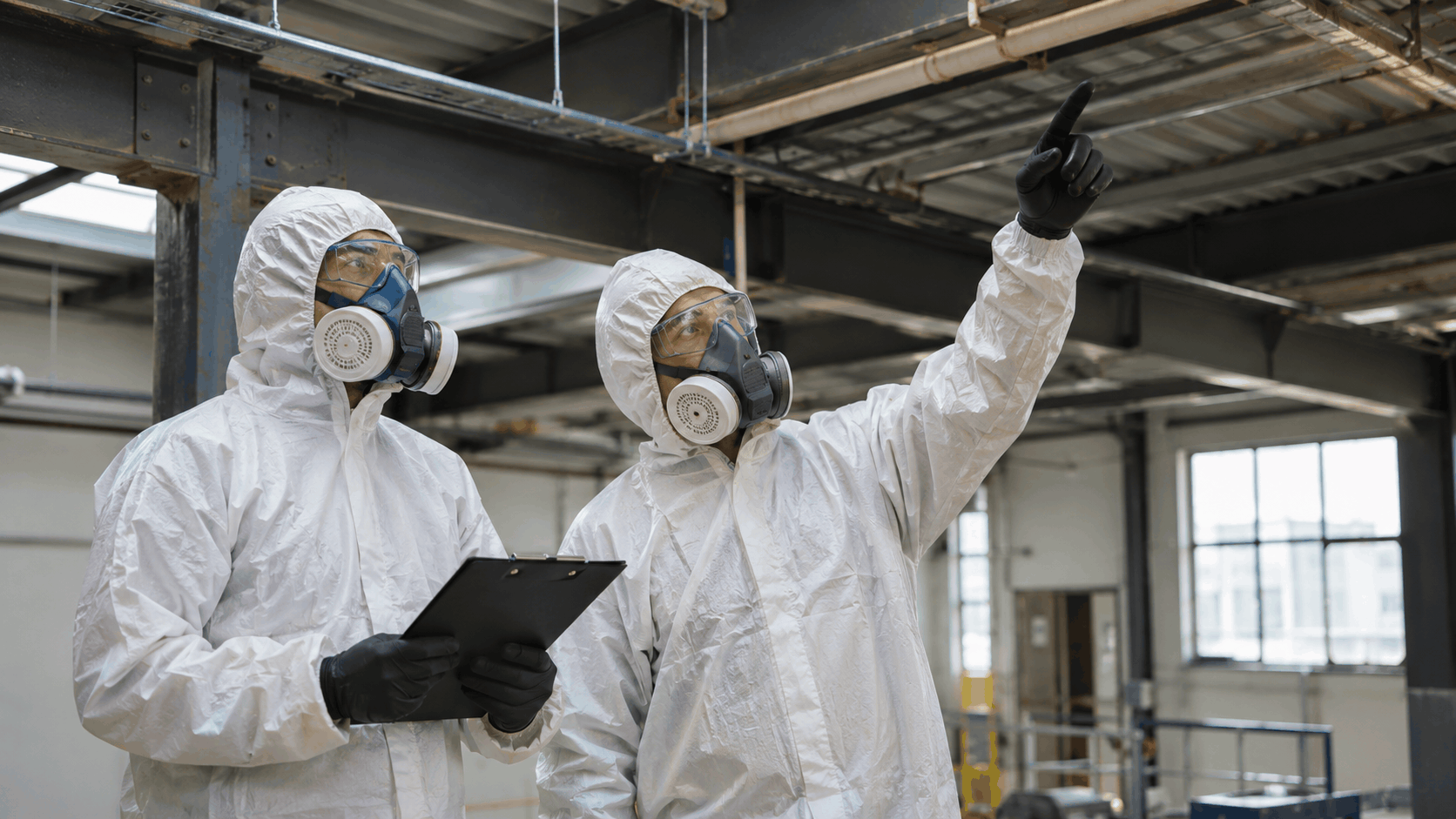
Sprayed asbestos coatings were once widely used to provide fire protection and insulation in commercial and industrial buildings, particularly on structural steelwork, beams and ceilings.
However, these coatings are among the highest-risk asbestos-containing materials because they can release dangerous fibres when damaged or disturbed.
In this guide, we’ll explain where sprayed asbestos coatings may be found, why they’re particularly hazardous and how they’re safely managed or removed.
Sprayed asbestos coatings were made by mixing asbestos fibres with binding materials and applying the mixture directly to building surfaces. They were commonly used to protect structural steelwork from fire, provide thermal insulation and help control condensation.
These coatings are sometimes referred to as limpet asbestos, a name associated with a historically used sprayed asbestos product.
Unlike decorative textured coatings such as Artex, which were applied primarily to create a patterned finish, sprayed asbestos coatings were used for functional insulation and fire protection. They also typically contained much higher concentrations of asbestos, making them particularly hazardous when disturbed.
Sprayed asbestos coatings were widely used in older commercial and industrial buildings, particularly where structural fire protection or insulation was required.
Common locations include:
In some buildings, sprayed asbestos coatings may be hidden above suspended ceilings, behind wall linings or within other enclosed spaces.
The spraying process could also leave asbestos-containing overspray and debris on surrounding surfaces. This means asbestos may be present beyond the visibly coated beams or ceilings, which is particularly important to consider before refurbishment or demolition work.
Sprayed asbestos coatings typically have a rough, uneven or fibrous appearance, sometimes resembling a thick, lumpy layer of plaster. They are often grey, white or off-white, although their colour and texture can vary.
Some coatings may have been painted or sealed, making their original appearance harder to recognise. Others may be completely concealed behind wall linings, above suspended ceilings or around structural steelwork.
However, you cannot reliably identify sprayed asbestos coatings by appearance alone. Other fireproofing and insulation materials can look similar, and professional testing is needed to confirm whether asbestos is present.
Never scrape, touch or break apart a suspected coating to investigate it, as even relatively minor disturbance can release asbestos fibres.
Sprayed asbestos coatings are considered one of the highest-risk asbestos-containing materials because they are highly friable. This means they can crumble or break apart easily, potentially releasing asbestos fibres into the air.
Unlike asbestos cement, where fibres are tightly bound within the material, sprayed coatings often contain a high proportion of asbestos with relatively weak binding materials.
The risk is particularly significant when coatings become damaged, deteriorate or are disturbed during building work. Activities such as drilling into coated steelwork, removing ceiling structures or carrying out demolition can release large quantities of airborne fibres.
Breathing in asbestos fibres can cause serious diseases, including mesothelioma, asbestosis and asbestos-related lung cancer.
Even where coatings appear intact, their condition and likelihood of disturbance need to be carefully assessed. Any work on sprayed asbestos coatings requires an appropriately licensed asbestos contractor because of the potential for significant fibre release.
If you suspect sprayed asbestos coatings are present in a building, the first step is to check any existing asbestos survey reports or asbestos registers to see whether the material has already been identified.
Where records are missing or incomplete, a professional asbestos survey can help establish what materials are present, their condition and whether further action is needed.
A suitably trained professional can collect representative samples for analysis by a UKAS-accredited laboratory. This is the only reliable way to confirm whether a suspected coating contains asbestos.
It’s particularly important to investigate concealed areas before refurbishment. Sprayed coatings may be hidden above ceilings or behind wall linings, and asbestos-containing overspray or debris may be present nearby.
Where planned work could disturb these areas, an appropriately scoped refurbishment and demolition survey will usually be required before work begins.
Not necessarily. Although sprayed asbestos coatings are considered high-risk materials, removal isn’t automatically required simply because they’re present.
If a coating is in good condition, adequately protected and unlikely to be disturbed, a professional assessment may determine that it can be managed safely in place. This involves recording its location, monitoring its condition and ensuring anyone carrying out future work is aware of it.
In some circumstances, encapsulation may also be an option. This involves professionally sealing or enclosing the coating to help prevent damage and fibre release.
However, where coatings are deteriorating, vulnerable to damage or likely to be disturbed during refurbishment or demolition, removal may be necessary.
Any work on sprayed asbestos coatings, including remedial treatment, must be assessed and carried out by an appropriately licensed asbestos contractor.
Because sprayed asbestos coatings are highly friable, their removal requires a contractor licensed by the Health and Safety Executive (HSE). Strict controls are needed to prevent asbestos fibres spreading beyond the work area.
Although the exact approach depends on the building and the extent of the material, a typical removal project involves several stages:
Where sprayed asbestos was originally applied to protect structural steelwork from fire, replacement fire protection may also be necessary once it’s removed.
This should be considered during the planning stage to ensure the building continues to meet its fire safety requirements.
For further information, see the HSE’s guidance on licensed asbestos work.
Malrod has experience managing complex sprayed asbestos removal projects, including work at the former civic offices in Newcastle-under-Lyme.
The project involved removing sprayed asbestos insulation from steel columns concealed within walls and steel beams above ceilings across three adjoining office blocks.
You can explore more examples of our work in our asbestos removal case studies.
If you’ve discovered suspected sprayed asbestos coatings in your building or are planning refurbishment work that could disturb them, Malrod can help.
With over 50 years of experience, we provide professional asbestos surveys and specialist removal services for commercial and industrial properties across the UK.
Whether you require industrial asbestos removal involving structural steelwork or commercial asbestos removal as part of a building refurbishment, our team can assess your requirements and advise on the appropriate next steps.
Contact Malrod to discuss your project or request a quote.
If you suspect a sprayed asbestos coating has been damaged, stop any work immediately and prevent people from entering the affected area.
Don’t attempt to clean up the debris, sweep the area or use a vacuum cleaner, as this could spread asbestos fibres.
Arrange for a licensed asbestos contractor to assess the situation and advise on the necessary precautions and clearance work.
This depends on the location and extent of the work, the building’s layout and whether the affected areas can be safely isolated.
Licensed asbestos removal typically involves sealed enclosures and strict controls to prevent fibres spreading. In some cases, other parts of the building may remain operational, while larger or more complex projects may require temporary closures.
The contractor should establish the necessary access restrictions and arrangements before work begins.
Building owners and managers should retain relevant removal documentation, including the Certificate for Reoccupation where required and asbestos waste disposal records.
The building’s asbestos register and management plan should also be updated to reflect the completed work and any asbestos-containing materials that remain.
These records help ensure future maintenance and refurbishment work can be planned safely.
Read more
October 12th, 2026
Noticed some old guttering or downpipes on your property that are starting to deteriorate or need replacing? If your building […]
Read more
September 30th, 2026
Before asbestos removal begins, there needs to be a written plan for how the work will be carried out safely. […]
Read more

September 28th, 2026
Asbestos in older boilers and industrial plant wasn’t only used in pipe lagging and other forms of insulation. It was […]