

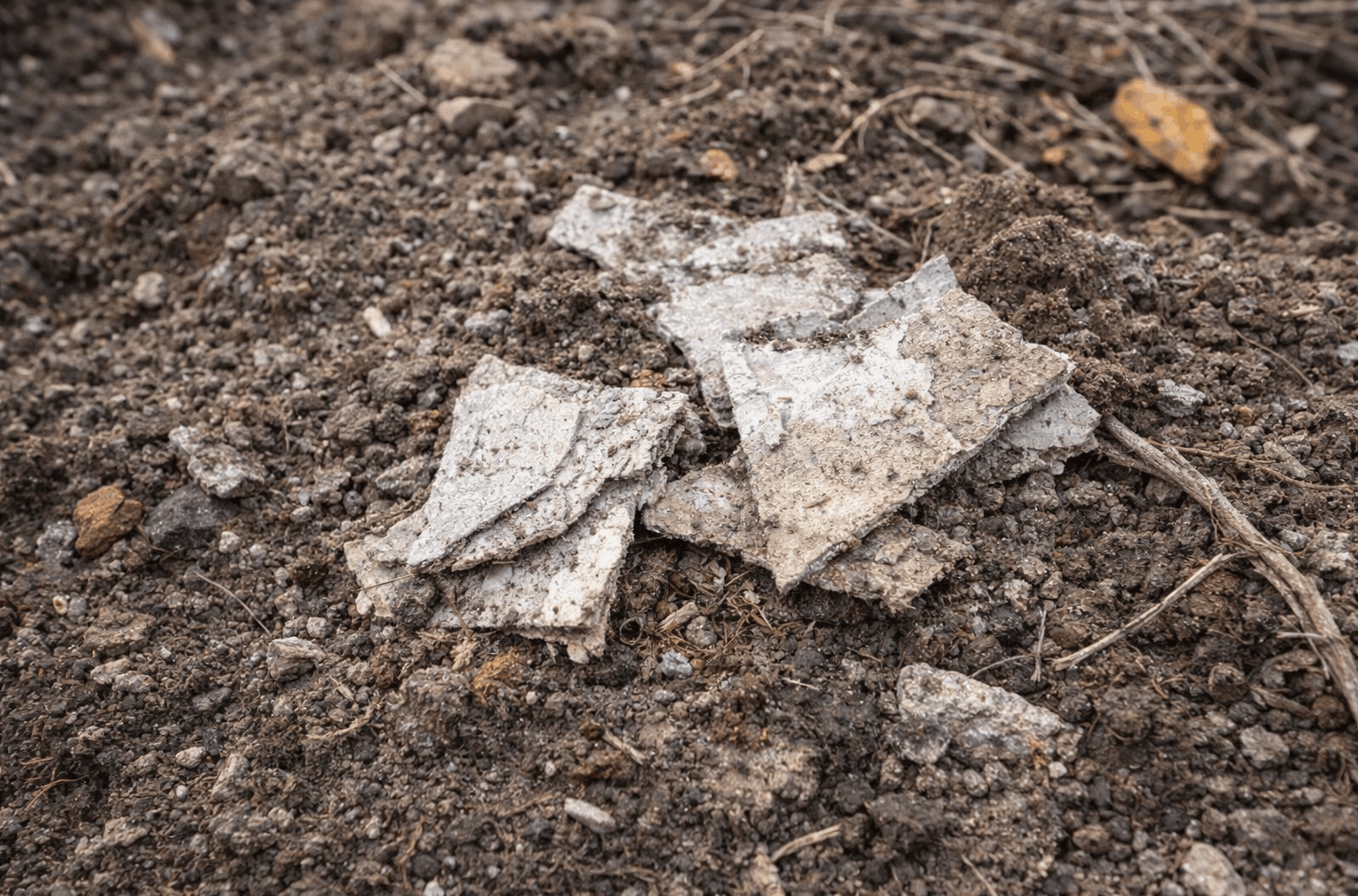
Asbestos in soil is a common issue on former industrial sites, demolition areas and brownfield land across the UK. While asbestos is often associated with buildings and insulation materials, it can also be present within made ground, buried demolition waste or contaminated fill.
The level of risk depends largely on whether the soil is disturbed. When left undisturbed and properly managed, asbestos‑contaminated soil may pose minimal immediate risk. However, excavation, construction, landscaping or groundworks can release asbestos fibres into the air, creating potential health and regulatory concerns.
For developers, landowners and contractors, understanding the risks and legal implications of asbestos in soil is essential. Early identification and appropriate remediation strategies can prevent project delays, enforcement action and costly redesigns.
How Does Asbestos End Up in Soil?
Asbestos typically enters soil as a result of past construction practices, demolition activities or historic industrial use. Before the UK ban in 1999, asbestos‑containing materials (ACMs) were widely used in buildings, manufacturing and infrastructure.
When these materials were damaged, demolished or poorly disposed of, contamination of surrounding ground often followed.
Common sources of asbestos in soil include:
Demolition Debris
Historically, demolition waste was frequently buried on site rather than removed to licensed disposal facilities. As buildings containing asbestos were knocked down, fragments of asbestos cement, insulation board or lagging were mixed into the ground.
Made Ground and Infill Materials
On brownfield and redevelopment sites, imported fill materials may contain asbestos fragments. “Made ground”, land that has been raised or re‑graded using construction or industrial waste, is a common source of contamination.
Fly‑Tipping and Illegal Disposal
Improper disposal of asbestos waste, including asbestos cement sheets or insulation materials, can lead to localised soil contamination.
Deterioration of Asbestos‑Containing Materials
Over time, external asbestos materials such as roofing sheets or cladding can degrade. Weathering and breakage may cause fragments to fall into surrounding soil.
Industrial Legacy Contamination
Certain industrial processes historically used asbestos. Sites formerly occupied by factories, power stations, shipyards or rail facilities may contain residual asbestos within the ground.
What Are the Risks of Asbestos in Soil?
The presence of asbestos in soil does not automatically mean there is an immediate danger. The level of risk depends on the type of asbestos present, its condition, concentration and, most importantly, whether the soil is disturbed.
The primary risk arises when asbestos fibres become airborne and are inhaled.
When Is Asbestos in Soil Dangerous?
Asbestos in soil becomes a concern when ground disturbance creates the potential for fibre release.
Activities that may increase risk include:
- Excavation and groundworks
- Trenching and utility installation
- Piling and foundation works
- Landscaping and earth moving
- Site clearance and grading
- Vehicle movement over contaminated ground
Dry, dusty conditions can further increase the likelihood of airborne fibre generation if adequate controls are not in place.
Undisturbed asbestos buried at depth and properly managed may present minimal exposure risk. However, construction and redevelopment activities can significantly alter that risk profile.
Health Risks
If asbestos fibres become airborne and are inhaled, they can lodge in the lungs. Long‑term or repeated exposure is associated with serious diseases, including:
- Mesothelioma
- Asbestosis
- Lung cancer
The risk is linked to cumulative exposure. For this reason, preventing fibre release during soil disturbance is the central focus of asbestos risk management.
Environmental and Project Risks
Beyond direct health considerations, asbestos in soil can create substantial commercial and regulatory implications.
These may include:
- Delays to construction programmes
- Planning condition requirements
- Unexpected remediation costs
- Reclassification of excavated soil as hazardous waste
- Enforcement action from regulators
- Increased scrutiny from environmental health authorities
Unexpected discovery of asbestos during construction can halt works immediately while investigations and control measures are implemented.
For developers and landowners, early site investigation is critical to reducing uncertainty and managing financial risk.
Legal and Regulatory Considerations in the UK
The management of asbestos in soil is governed by several areas of UK legislation. Responsibility typically falls on landowners, developers, employers and those in control of construction works.
Understanding the regulatory framework is essential to avoid enforcement action and project delays.
Control of Asbestos Regulations 2012
The Control of Asbestos Regulations 2012 (CAR 2012) apply where asbestos may be disturbed during work activities.
If construction, excavation or remediation works could expose workers to asbestos fibres, employers must:
- Assess the risk
- Prevent or adequately control exposure
- Provide appropriate training and controls
- Use licensed contractors where required
Even when asbestos is present in soil rather than buildings, CAR 2012 may apply if fibres could be released during groundworks.
Environmental Protection Act 1990
Under the Environmental Protection Act, asbestos‑contaminated soil may be classified as hazardous waste, depending on its concentration and form.
This affects:
- How the material is handled
- Transport requirements
- Disposal at licensed facilities
- Waste documentation and duty of care
Improper handling or disposal can lead to prosecution and significant fines.
Contaminated Land Regime (Part 2A)
Local authorities have powers under Part 2A of the Environmental Protection Act to identify and manage contaminated land where it poses a significant risk to human health or the environment.
Where asbestos in soil presents an unacceptable risk, remediation may be required.
Responsibility may fall on:
- The party who caused the contamination (where identifiable), or
- The current landowner or developer
Construction (Design and Management) Regulations 2015
Under CDM Regulations, duty holders must ensure that risks are identified and managed before construction begins.
This includes:
- Undertaking appropriate site investigations
- Providing contractors with relevant pre‑construction information
- Implementing safe systems of work
Failure to identify asbestos in soil at the planning stage can result in work stoppages and enforcement action once construction is underway.
In practice, early site investigation and clear remediation planning are the most effective ways to demonstrate compliance and reduce liability.
How Is Asbestos in Soil Identified?
Identifying asbestos in soil requires a structured site investigation carried out by competent environmental or asbestos specialists.
The approach will depend on the site’s history, proposed land use and level of redevelopment planned.
Early investigation reduces uncertainty and helps inform proportionate remediation strategies.
Phase 1: Desk Study and Risk Assessment
The process typically begins with a Phase 1 Desk Study, which includes:
- Review of historical maps
- Previous site uses
- Planning records
- Environmental databases
- Site walkover inspection
This stage helps determine whether there is a reasonable likelihood of asbestos contamination, particularly on former industrial, demolition or brownfield sites.
Phase 2: Intrusive Site Investigation
If a potential risk is identified, a Phase 2 Site Investigation may be required.
This involves:
- Trial pits or boreholes
- Soil sampling at various depths
- Visual screening for asbestos fragments
- Controlled handling procedures
Samples are then sent to a UKAS‑accredited laboratory for analysis.
Laboratory Testing and Analysis
Laboratory analysis confirms:
- Whether asbestos is present
- The type of asbestos fibre
- The concentration within the soil
Testing may include identification of visible fragments as well as more detailed quantification methods where finer fibres are suspected within the soil matrix.
It is important to distinguish between:
- Asbestos cement fragments (often visible and easier to manage)
- Free fibres or fibrous asbestos dispersed in soil, which may present a higher risk if disturbed
The results of site investigation and laboratory testing inform the risk assessment and determine whether remediation or management measures are required.
Remediation Strategies for Asbestos‑Contaminated Soil
The appropriate remediation strategy depends on several factors, including:
- The type and concentration of asbestos present
- Whether fibres are bound within fragments or dispersed in soil
- The proposed future use of the land
- The likelihood of disturbance
- Regulatory requirements
In many cases, remediation focuses on breaking the exposure pathway, preventing asbestos fibres from becoming airborne and being inhaled.
1. Excavation and Off‑Site Disposal
Excavation and removal is one of the most common remediation approaches.
This involves:
- Carefully excavating contaminated soil
- Segregating asbestos‑containing materials
- Transporting waste under controlled conditions
- Disposing of material at licensed hazardous waste facilities
Depending on asbestos content, soil may be classified as hazardous waste, requiring specific handling and documentation.
While effective, this approach can be costly, particularly on large sites.
2. On‑Site Screening and Segregation
On some sites, mechanical screening techniques can be used to remove visible asbestos fragments from soil.
This process may involve:
- Controlled soil screening
- Manual picking of asbestos cement fragments
- Segregation of contaminated materials
Screened soil may then be reassessed to determine whether it meets criteria for reuse on site.
This approach can reduce disposal volumes and project costs but must be carried out under strict control measures.
3. Capping and Containment
Where asbestos contamination is present at low levels and the site is not intended for sensitive use, containment may be an appropriate solution.
This may involve:
- Installing a clean soil cover layer
- Hardstanding (concrete or tarmac)
- Geotextile marker membranes
- Landscaping barriers
Capping systems prevent disturbance and break the exposure pathway without removing all contaminated soil.
Long‑term management plans are usually required to maintain the integrity of the cover system.
4. Encapsulation
Encapsulation involves stabilising contaminated material in place to prevent fibre release.
This strategy may be suitable in controlled development settings where contamination is localised and can be permanently sealed beneath structures or hard surfaces.
5. Controlled Development Strategies
In some cases, remediation is integrated into the construction process.
Examples include:
- Designing foundations to avoid heavily contaminated zones
- Restricting excavation depths
- Implementing dust suppression and air monitoring during works
- Using defined material management plans
This risk‑based approach ensures worker protection while allowing development to proceed safely and compliantly.
Selecting the correct remediation strategy requires a detailed risk assessment and collaboration between environmental consultants, asbestos specialists and project stakeholders.
Managing Asbestos in Soil During Construction
Where asbestos is known or suspected to be present in soil, strict control measures must be implemented during construction and groundworks to prevent fibre release and protect workers.
Effective management relies on planning, supervision and clear method statements before work begins.
Risk Assessment and Method Statements
Before excavation starts, contractors should prepare:
- A site‑specific risk assessment
- An asbestos management or remediation plan
- Detailed method statements outlining control measures
- Emergency procedures in case unexpected contamination is encountered
All personnel involved in ground disturbance must be informed of the risks and control requirements.
Dust Suppression and Control
Preventing the generation of airborne dust is critical. Control measures may include:
- Damping down soil during excavation
- Using water suppression systems
- Avoiding dry handling of contaminated material
- Minimising drop heights during loading
Work may need to stop during high winds or dry conditions if adequate dust control cannot be maintained.
Segregation and Exclusion Zones
Clearly defined work areas should be established to limit the spread of contamination.
This may involve:
- Fencing or barrier systems
- Controlled access points
- Designated routes for contaminated material
- Separate stockpile areas
Segregation reduces the risk of cross‑contamination across the site.
Personal Protective Equipment (PPE)
Where required, workers may need:
- Suitable respiratory protective equipment (RPE)
- Disposable coveralls
- Gloves and appropriate footwear
PPE should form part of a broader control strategy and not be relied upon as the sole protective measure.
Air Monitoring and Verification
In higher‑risk situations, air monitoring may be undertaken to:
- Assess fibre levels
- Verify the effectiveness of control measures
- Demonstrate regulatory compliance
Clear documentation and record‑keeping are essential throughout the project.
With proper planning and professional oversight, construction can proceed safely even where asbestos in soil has been identified.
When Should You Arrange Professional Support?
Early specialist input is the most effective way to reduce uncertainty, control risk and prevent costly disruption.
Professional support should be considered in the following situations:
You Are Purchasing or Developing Brownfield Land
If a site has a history of industrial use, demolition or landfilling, asbestos contamination may be present within made ground. A structured site investigation before acquisition or planning submission can identify liabilities early.
Planning Conditions Require Site Investigation
Local authorities often require contaminated land assessments as part of the planning process. Identifying asbestos in soil at this stage allows remediation strategies to be agreed before construction begins.
Excavation or Groundworks Are Planned
If works will disturb soil on land built before 2000 or previously developed, an asbestos risk assessment should be undertaken. Unexpected discoveries during excavation can halt works immediately.
Asbestos Is Discovered During Construction
If suspected asbestos fragments are uncovered on site, work should stop in the affected area until material is assessed by a competent specialist. Prompt investigation helps limit delays and regulatory scrutiny.
You Need a Remediation Strategy
Selecting the correct remediation approach requires technical knowledge of:
- Waste classification
- Exposure pathways
- Regulatory requirements
- Practical construction constraints
A proportionate, risk‑based strategy can significantly reduce unnecessary removal and disposal costs while maintaining compliance.
Engaging experienced asbestos and environmental specialists at an early stage helps protect workers, maintain programme timelines and provide confidence to regulators and stakeholders.
For expert advice on asbestos in soil investigations, risk assessment and remediation, speak to our team at Malrod.
Asbestos in Soil FAQs
Is asbestos in soil always dangerous?
Not always. Risk arises when contaminated soil is disturbed and fibres become airborne.
Can you build on land contaminated with asbestos?
Yes, provided the site is properly assessed and appropriate remediation or containment measures are in place.
How much asbestos in soil is considered hazardous?
There is no single fixed limit. Risk depends on concentration, fibre type, soil conditions and proposed land use.
Does asbestos‑contaminated soil require licensed removal?
Not in every case. Requirements depend on the type of asbestos and the nature of the work, but disposal is often regulated as hazardous waste.
Can asbestos‑contaminated soil be reused on site?
Sometimes, under a controlled materials management plan and following appropriate testing and risk assessment.
Who is responsible for asbestos in soil?
Liability may fall to the original polluter (if identifiable) or the current landowner or developer.
What should I do if asbestos is found during excavation?
Stop work in the affected area and seek assessment from a qualified asbestos specialist.